
Appearance
Hierarchy OEL's Chemical Substances
Hierarchy OEL's Chemical Substances
For the inclusion of Occupational Exposure Limits in DOHSBase Compare a structural hierarchy is used.
The basis for the hierarchy for OEL's is the 'Guideline for Limit Values' developed by the Dutch Socal and Economic Council (SER) in 2007. We have adapted this hierarchy to the latest insights and developments concerning REACH and the DNEL's. DOHSBase Compare has been using a hierarchy since 2015 that is propagated internationally. The hierarchy is presented in the image below.
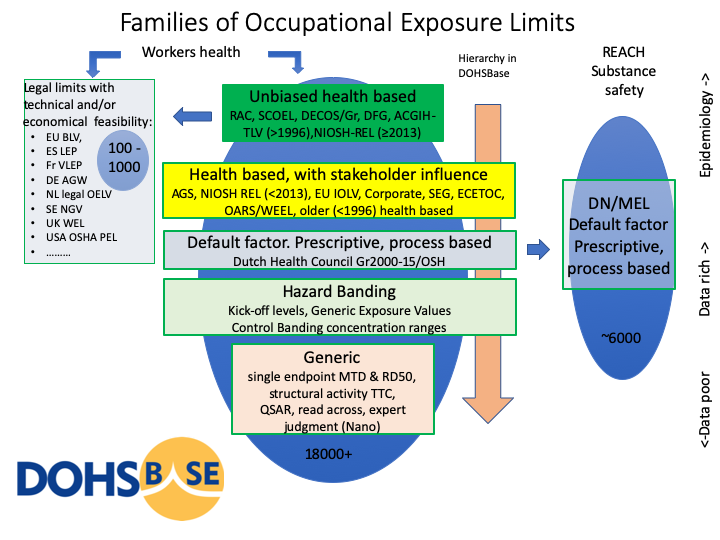
The national legal OEL's are presented in each database version. In addition, the reference to the European Derived No-Effect Levels (DNELs) are also presented. As DNEL's can change without notice we advice to check always at the website of ECHA (www.echa.europe.eu; 'Search for Chemicals'; Registered substances database) the up to date value of the DNEL for a specific substance.
Compared to the original source (s) the following changes are made:
- Group OELVs: for metals in particular, the OELV is often given as 'Metal X and compounds'. The CAS number of the elementary metal X is stated in the OELV list. The X-compounds are not mentioned in more detail (no name and CAS number). In DOHSBase Compare, the individual X-compounds from the supporting advisory reports (DECOS, SCOEL, IARC, AGS) are linked to the OELV of the metal. Furthermore, an algorithm links the OELV to the individual X-compounds. As a result, all known X-compounds have been given an OELV.
- In Germany two types of MAK-lists are used. First the MAK values which are derived by the "DFG Commission for the Investigation of Health Hazards of Chemical Compounds in the Work Area", exclusively on the basis of scientific arguments and are published in the "List of MAK and BAT Values" which is issued annually by DFG. Next to this, there are the MAK-values based on the Hazardous Substances Ordinance (GefStoffV) which is derived from the Chemicals Act (ChemG). All exposure limit values are consistent national values based on common national legislation. The Federal Ministry of Labour and Social Affairs publishes new or revised limit values half-yearly. The MAK and TRK (Technische Richtkonzentration, OELs for certain carcinogenic substances) values are published in TRGS 900 (Limit Values in the Air at the Workplace) and the BAT are covered in TRGS 903. In DOHSBase Compare the MAK-values of DFG are presented.
Also for the Limit Values for exhaled air and in blood and urine a hierarchy is maintained. However, because the Limit Values for Biological Monitoring are strongly defined in terms of sampling procedure and media, analysis, etc., sometimes multiple values for a substances are included in DOHSBase Compare from different hierarchical levels. In DOHSBase Compare the following hierarchy is used for Limit Values for exhaled air and blood and urine:
Legally binding Limits (public) --> EU-IOELV's and EU-BLV's --> Guideline Values of DECOS (after 1997) -> Guideline Values of SCOEL (after 1997) --> Guideline Values of DECOS/WGD (before 1997) WGD--> Guideline Values of SEG (before 1997) --> Germany (BAT - DFG) --> USA (BEI - ACGIH) --> Limits published in peer reviewed scientific publications -> Limits from research institutes, universities and companies
For the hierarchy of measurement methods for chemical substances: click here.