Appearance
Purpose and Description of the Software
Purpose and Description of the Software
With DOHSBase Compare it is possible to:
- Check quickly whether there are existing Occupational Exposure Limits and Occupational Hygiene Measurement Methods for the substance involved;
- Get advice how to sample and analyse the substance;
- Make a comparison between different substances in terms of the risk potential in the work place atmosphere. By doing so a so called 'Risk Assessment Score' (RAS) is being calculated in the Compare Mode.
There are several different types of substances of which data on Occupational Exposure Limits and Measurement Methods are included in the software. An overview of the types of substances in DOHSBase Compare is given here.
The identity of the substance is described by its name and synonyms (many versions), Identification numbers, EU-CLP-information (symbols, H-phrases and the categorization into Carcinogenic, Toxic to Reproduction and Mutagenic). This is done in the Tabs 'Identification' and 'Properties'.
The available Occupational Exposure Limits (OELs) are presented in the tab 'Limit Values'. In the NL-versions (NL-Standard and NL-Xtend) the information source is primary of Dutch origin. When Dutch Limit Values or EU-values are non-existent, DOHSBase Compare sources of other countries are added. Therefore a structural hierarchy is used. Next to the Exposure Limit(s), the reference time and the source of the Occupational Exposure Limit is presented. For the EU-version (EU-Xtend) the basis are the indicative and binding limit values (IOELV and BLV) of the European Union. If there are no EU-values available, also a hierarchy is used to present Occupational Limit Values of other origin.
If Biological Limit Values are available for the substances, they are also presented, using a hierarchy.
The Measurement Methods are presented in the 'Sampling Methods'. This tab is only available in the Search & Find Mode and not in the Compare Mode. For the Measurement Methods the rich source of European- and Dutch Norms Institutes are being used (CEN and NEN). When information is missing sources from other countries, using a structured hierarchy, have been used to complete the information.
Some of the OELs are connected to several substances (like Mercury). Other substances have more than one OEL (like Lead:15) and also more Measurement Methods (like Styrene). The OELs and Measuement methods are coupled if the reference periods and sampling time are the same.
How to assess the risks at the workplace and which measuring strategy needs to be applied, whether measuring is meaningful, or how to assess and extrapolate the outcome of the measurements to different time periods is not available in DOHSBase Compare. Neither gives it information about Quality Assurance Systems, Health Risks or Health Management and Control Measures. Such information can be found in many other publications.
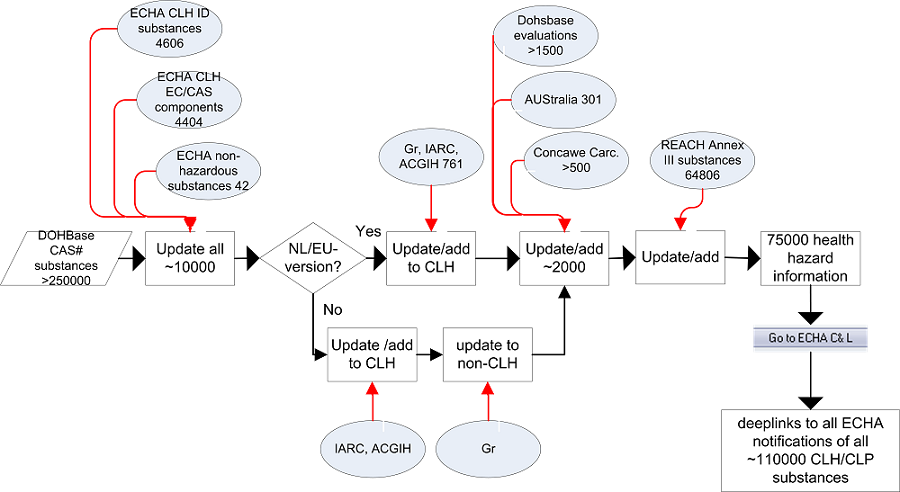
The diagram below shows how the various sources are processed in the program (situation and numbers: 1-1-2019).